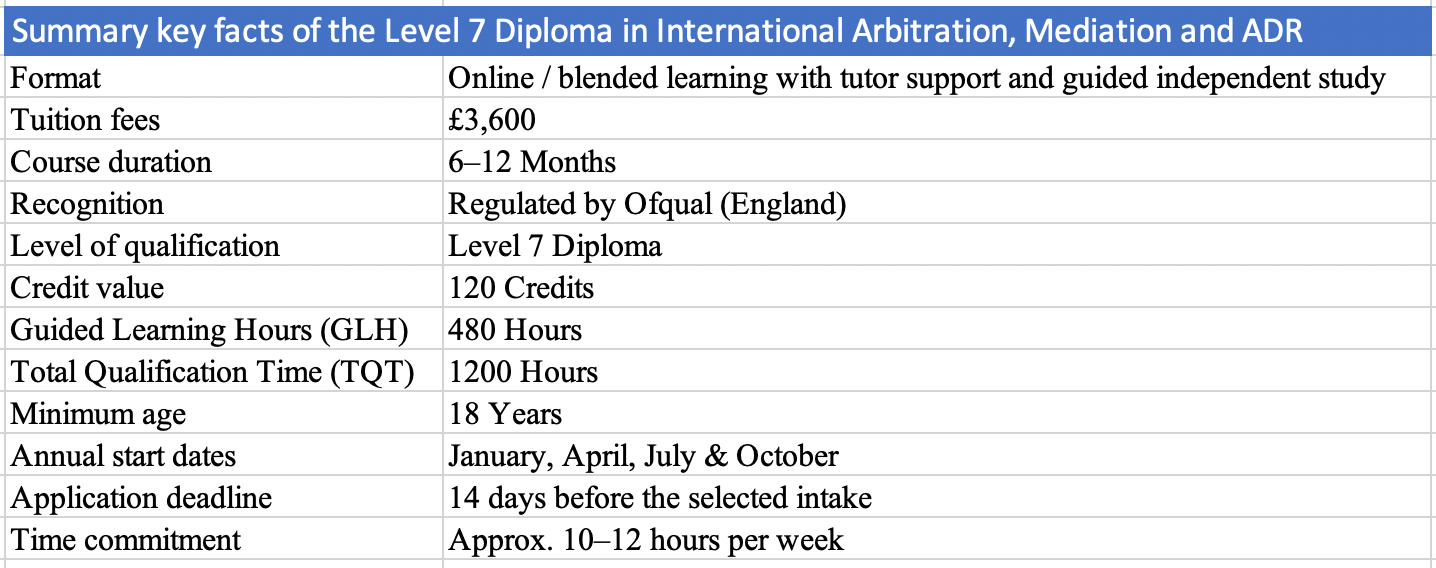
About Course
Why the qualification and who is it for?
- Legal professionals and consultants
- Arbitration and mediation practitioners
- Business executives and corporate managers
- Compliance and risk professionals
- Entrepreneurs and business owners
- Contract managers and negotiators
- International trade professionals
- Graduates seeking specialist dispute resolution expertise.
The qualification provides progression opportunities into postgraduate study, professional arbitration practice, mediation services, and leadership roles within international dispute resolution environments.
Qualification Structure:
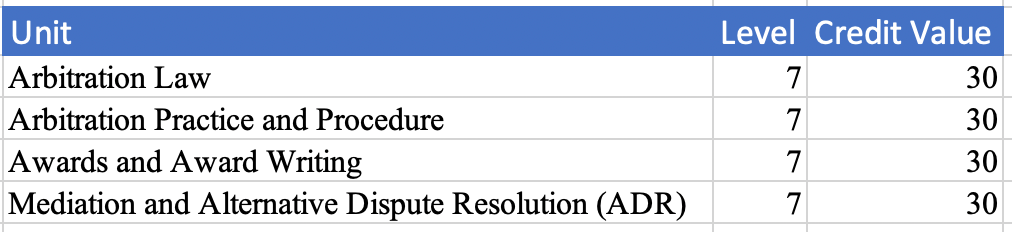
The qualification comprises 4 mandatory units. Learners must achieve 120 credits in total.

Arbitration Law:
This unit is a study of the principles of law in international commercial arbitration.
Learners will examine the legislative framework based on the UNCITRAL Model Law on International Commercial Arbitration and understand the legal foundations that support modern international arbitration practices. The unit explores global arbitration systems, arbitral institutions, investment treaty arbitration, arbitration agreements, jurisdictional matters, and the role of national courts in arbitration proceedings. Learners will develop the ability to analyse legal frameworks, interpret arbitration agreements, examine arbitration procedures, and apply arbitration principles in professional and commercial settings.
Key Topics Include:
- Principles of international commercial arbitration
- UNCITRAL Model Law and Arbitration Rules
- New York Convention 1958
- National legal systems and arbitration
- Investment treaty arbitration and ICSID
- Arbitration agreements and enforceability
- Multiparty arbitration disputes
- Confidentiality and jurisdictional issues
Arbitration Practice and Procedure:
This unit focuses on the practical conduct and procedural management of arbitration proceedings.
Learners will study the commencement of arbitral proceedings, tribunal formation, appointment of arbitrators, jurisdictional considerations, and the procedural stages involved in arbitration. The unit develops practical understanding of hearings, evidential procedures, written submissions, burden of proof, witness examination, and advocacy techniques used throughout arbitration processes. Learners will also gain insight into ethical responsibilities, tribunal powers, and hearing preparation within both domestic and international arbitration environments.
Key Topics Include:
- Formation and appointment of arbitral tribunals
- Seat of arbitration and tribunal independence
- Duties and powers of arbitrators
- Jurisdictional challenges and ethical considerations
- Arbitration procedures from dispute initiation to outcome
- Evidence collection and burden of proof
- Hearing preparation and advocacy
- Examination and cross-examination techniques
Awards and Award Writing
This unit examines the drafting, validity, enforceability, and structure of arbitral awards.
Learners will study different types of arbitral awards, remedies available to parties, allocation of costs, enforcement procedures, and challenges to awards under international arbitration frameworks. The unit also develops practical award-writing skills, enabling learners to evaluate evidence, determine outcomes, prepare reasoned decisions, and draft professionally structured arbitral awards. Learners will build analytical and judgement-based skills necessary for producing fair, enforceable, and well-reasoned arbitration decisions.
Key Topics Include:
- Types and validity of arbitral awards
- Remedies and allocation of costs
- Enforcement and challenge procedures
- New York Convention enforcement principles
- Setting aside of awards under UNCITRAL Model Law
- Award drafting and publication
- Reasoned findings and evidential analysis
- Decision-making and outcome determination
Mediation and Alternative Dispute Resolution (ADR)
This unit explores the principles, procedures, and legal frameworks governing mediation and alternative dispute resolution practices.
Learners will examine dispute management strategies, mediation theories, communication techniques, cultural influences in disputes, and legal aspects surrounding mediation processes. The programme also introduces learners to UNCITRAL mediation instruments, mediation agreements, mediator responsibilities, and settlement agreement drafting. Through practical and analytical learning, learners will understand how mediation can be applied effectively to resolve commercial and cross-border disputes.
Key Topics Include:
- Dispute management strategies
- Communication and conflict resolution techniques
- Cross-cultural dispute management
- Legal frameworks governing mediation
- Confidentiality and neutrality in mediation
- Settlement agreements and enforcement
- UNCITRAL Mediation Rules and Singapore Convention
- Mediation procedures from commencement to conclusion
Entry Requirement
Prospective learners should satisfy one of the following criteria:
- A Level 6 qualification in law, business, or a related discipline
- Equivalent professional qualifications or relevant work experience
- Appropriate English language proficiency
- Ability to undertake study at postgraduate level.
Applicants with substantial professional experience may also be considered on a case-by-case basis.
Application Process
Prospective learners can apply through the admissions process by submitting:
- Completed application form
- Academic qualifications and supporting documents
- Updated CV or professional profile
- Proof of identity
- English language evidence (where applicable)
Applications are reviewed by the admissions team, and eligible candidates may be invited for further assessment or discussion before enrolment.
Assessments
Assessment methods are designed to evaluate both theoretical understanding and practical application of dispute resolution skills.
Assessment activities may include:
- Case studies
- Reports and research projects
- Written assignments
- Oral presentations
- Practical demonstrations
- Arbitration and mediation simulations
- Award drafting exercises
- Portfolio-based assessments
All assessments are internally assessed and externally moderated in accordance with OCN London quality assurance standards.
There is no additional external examination for this qualification.Learning Outcomes
On successful completion of the qualification, learners will be able to:
- Apply advanced arbitration and mediation principles in professional practice
- Analyse and resolve complex commercial disputes
- Interpret international legal and regulatory frameworks
- Conduct arbitration and mediation procedures effectively
- Draft arbitration agreements, awards, and settlement agreements
- Evaluate evidence and formulate reasoned dispute resolution outcomes
- Demonstrate ethical and professional judgement in dispute management
- Communicate effectively within international dispute resolution environments
Career Progression
Successful completion of this qualification may support progression into:
- International Arbitration Practice
- Mediation and ADR Consultancy
- Commercial Dispute Resolution Roles
- Legal Advisory Services
- Compliance and Risk Management
- Corporate Negotiation and Contract Management
- Further Postgraduate Study
- Specialist Dispute Resolution Consultancy